
Besakih Temple, known locally as Pura Besakih or Pura Agung Besakih, is Bali’s largest and most important Hindu temple complex, located on the southwestern slopes of Mount Agung in Karangasem, East Bali. Widely referred to as the “Mother Temple of Bali,” it is believed to date back many centuries, with its origins tied to a combination of ancient megalithic worship, Hindu-Buddhist influence, and the historical development of Balinese kingdoms. Today, Besakih functions as the central temple for Balinese Hinduism, hosting ceremonies attended by communities from across the island.
As a Bali-based tour operator who has guided travelers through East Bali for over three decades, I’ve found that most visitors arrive knowing Besakih is important, but not why — and the real story, sorting documented history from religious tradition, makes the visit far more meaningful.
What Is Besakih Temple?
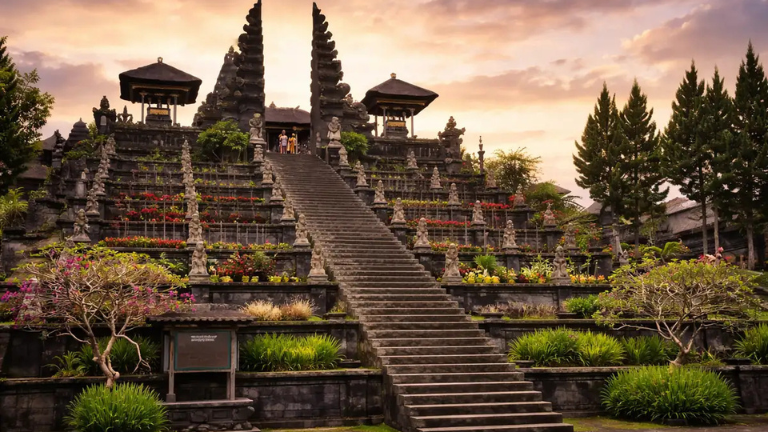
Besakih Temple is not a single structure but a complex of more than twenty separate temples arranged across terraced slopes on Mount Agung. The largest and most central of these is Pura Penataran Agung, which sits on the primary axis and is often what people picture when they think of “Besakih Temple.” The complex as a whole functions as the most significant temple in Balinese Hinduism, serving a role comparable to a central or “mother” religious site for the island.
Where Is Besakih Temple Located?
The temple complex is located in Besakih village, in the Rendang district of Karangasem regency, East Bali, on the slopes of Mount Agung at roughly 1,000 meters above sea level. It sits a considerable distance from Bali’s main tourist hubs – typically 2–2.5 hours from Ubud, and 3–3.5 hours or more from Canggu, Seminyak, or Kuta, depending on traffic and road conditions. Travelers based in East Bali areas like Candidasa or Amed are considerably closer, usually within 1–1.5 hours.
What Is the History of Besakih Temple?
The documented history of Besakih is complex, and historians and archaeologists generally distinguish between several layers of development rather than a single founding event.
Archaeological evidence, including stone terraces and megalithic structures found at the site, suggests the location was used for worship long before the arrival of Hindu-Buddhist influence in Bali, possibly connected to indigenous ancestor and mountain veneration practices. As Hinduism and Buddhism spread through Bali in the following centuries, these existing sacred sites were gradually incorporated into the developing Hindu temple system, with Besakih emerging as a central point of worship tied to Mount Agung.
Balinese historical chronicles and inscriptions associate the temple’s growth with successive ruling dynasties, including the Gelgel and later Klungkung kingdoms, who expanded and formalized the complex as a royal and religious center between roughly the 14th and 17th centuries. It’s worth noting that exact founding dates for Besakih are debated among historians, and much of its earliest history is pieced together from inscriptions, oral tradition, and archaeological context rather than a single definitive record.
How Old is Besakih Temple?
Because Besakih developed in layers rather than from one founding date, estimates of its age vary. The site’s earliest stone structures are believed by some archaeologists to predate the 10th century, while its formal development as a major Hindu temple complex is more firmly tied to Bali’s Hindu kingdoms from roughly the 14th century onward. Rather than citing a single exact age, it’s more accurate to describe Besakih as having ancient roots that were progressively built upon over many centuries.
Why Is Besakih Temple Called the Mother Temple of Bali?
Besakih is called the “Mother Temple” because of its central role in Balinese Hinduism – it is considered the most important temple on the island and holds significance for all Balinese Hindus, regardless of which village or clan temple they belong to. Unlike most Balinese temples, which serve a specific family, village, or irrigation community, Besakih’s ceremonies and status are understood to extend across the entire island.
What Is the Connection Between Besakih Temple and Mount Agung?
Mount Agung is Bali’s highest and most sacred mountain, regarded in Balinese Hindu belief as the abode of ancestral and divine spirits, and often spiritually linked to Mount Meru, the cosmic mountain in Hindu cosmology. Besakih’s location on Agung’s slopes is not incidental – in Balinese Hindu belief, mountains are sacred and temples are frequently positioned in relation to them, with Besakih representing the most significant example of this mountain-temple relationship on the island.
Who Built Besakih Temple?
No single individual or clearly documented founder is credited with building Besakih. Instead, Balinese tradition and historical evidence point to a gradual development involving early indigenous worship practices, later formalized and expanded by Bali’s Hindu-Buddhist kingdoms, particularly the Gelgel and Klungkung dynasties, who are credited with much of the temple’s structural growth and religious formalization.
Why Is Besakih Temple Important to Balinese Hinduism?
Besakih functions as the apex of Bali’s temple hierarchy, hosting ceremonies that draw worshippers from across the island rather than a single local community. It is closely tied to the broader structure of Balinese Hindu temple worship, where village, irrigation, and ancestral temples all exist in relation to larger, island-wide sacred sites – with Besakih occupying the most significant position in that structure.
What Is the Religious Significance of Besakih Temple?
Within Balinese Hindu belief, Besakih is associated with the Hindu Trimurti – the three principal manifestations of the divine, representing creation, preservation, and dissolution — with different shrines within the complex traditionally linked to these aspects. Major ceremonies held at Besakih are considered significant events in the Balinese Hindu calendar, drawing large numbers of worshippers, particularly during temple anniversary festivals (odalan) and larger island-wide purification ceremonies.
What Is the Architecture of Besakih Temple Like?
Besakih’s architecture follows traditional Balinese temple design, built across a series of ascending terraces that climb the mountain slope, a layout believed to reflect the sacred, ascending nature of Mount Agung itself. The complex features numerous multi-tiered meru shrines (pagoda-like towers with thatched roofs), split gateways (candi bentar), and walled courtyards, all constructed primarily from local volcanic stone. Because the complex has developed over many centuries and undergone periodic reconstruction, including repairs after volcanic activity, its architecture reflects a layered history rather than a single consistent building period.
What Are the Most Important Besakih Temple Facts?
Key facts about Besakih Temple:
- It is Bali’s largest Hindu temple complex, made up of more than twenty individual temples
- It is located on the slopes of Mount Agung, Bali’s highest and most sacred volcano
- It is widely known as the “Mother Temple of Bali” due to its island-wide religious significance
- Its earliest structures are believed to predate the formal arrival of Hinduism in Bali
- Its formal development as a major temple complex is associated with the Gelgel and Klungkung dynasties
- It has survived several major eruptions of Mount Agung, including a significant one in 1963
- The central temple, Pura Penataran Agung, sits on the complex’s main axis
- It remains an active religious site, hosting large ceremonies throughout the Balinese Hindu calendar
What Are the Main Temples Inside the Besakih Temple Complex?
The Besakih complex includes over twenty temples, with Pura Penataran Agung as the central and most prominent structure, positioned along the main terraced axis. Other notable temples within the complex are dedicated to specific aspects of Balinese Hindu belief and local clan groups, though most visitors focus their time around the main Penataran Agung courtyards, as deeper access into the complex is generally reserved for worshippers rather than general tourism.
What Should Visitors Know Before Visiting Besakih Temple?
Besakih is an active religious complex, not a conventional tourist site, and visitor access is more restricted than at temples like Tanah Lot or Ulun Danu Bratan. A sarong and sash are required, modest dress is expected throughout, and visitors should be prepared to stay within designated visitor areas rather than entering courtyards reserved for active worship. Because Besakih sits close to an active volcano, it’s also worth checking current conditions before a visit, as access can occasionally be affected by volcanic activity or large ceremonies — a local operator can confirm current conditions on the day.
Given the distance from South Bali and Ubud, many travelers combine Besakih with other East Bali destinations such as the Sidemen rice terraces, Tirta Gangga’s water gardens, Taman Ujung, or Lempuyang Temple. However, because East Bali’s roads wind through hill terrain and travel times vary significantly depending on traffic, weather, and your starting point, it’s not realistic to assume every attraction fits into a single fixed-route day. Consulting a local Bali tour operator to plan realistic pacing – rather than following a generic online itinerary, generally results in a far better experience.
What Is the Best Time to Visit Besakih Temple?
Morning visits, generally before mid-morning, tend to offer clearer views of Mount Agung before clouds build up later in the day, along with cooler temperatures for the walk around the complex. As with entrance fees and opening hours, conditions and regulations can change, so it’s worth confirming current details with a local operator or official source before your visit rather than relying on older online information.
Frequently Asked Questions
How old is Besakih Temple? Its exact age is debated, as the site developed in layers, early stone structures may predate the 10th century, while its major formal development as a Hindu temple complex is tied to Balinese kingdoms from roughly the 14th century onward.
Why is Besakih Temple called the Mother Temple of Bali? It holds the highest position in Bali’s temple hierarchy, with religious significance extending across the entire island rather than to a single village or family, making it the central reference point for Balinese Hindu worship.
Where is Besakih Temple located? Besakih is located in Besakih village, Rendang district, Karangasem regency, on the slopes of Mount Agung in East Bali.
Can tourists visit Besakih Temple? Yes, tourists can visit the main temple areas with appropriate dress and respectful conduct, though access to certain courtyards is reserved for worshippers, particularly during active ceremonies.
Planning to visit Besakih Temple and explore East Bali? Docar Bali Tour can help put together a private itinerary around Besakih, Mount Agung, and nearby East Bali destinations like Sidemen, Tirta Gangga, or Lempuyang Temple — paced realistically around your hotel location, available time, and interests. Message us on WhatsApp through docarbalitour.com to start planning.