
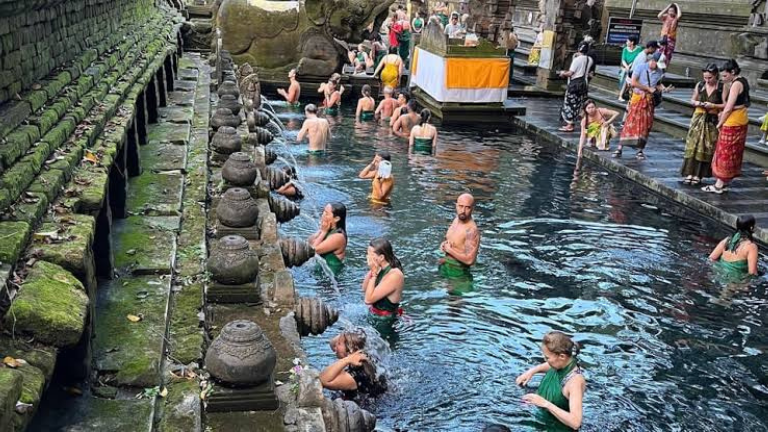
Pura Tirta Empul is a sacred Hindu water temple in Tampaksiring, central Bali, built around 962 AD and famous for its holy spring water, which Balinese Hindus and visitors use in a purification ritual called melukat. The temple’s name, Tirta Empul, translates roughly to “holy spring,” referring to the natural water source that bubbles up inside the temple complex and is believed to have purifying, healing properties. Today it remains one of Bali’s most visited and spiritually significant sites, drawing both devout worshippers and travelers curious about Balinese Hindu culture.
Having guided visitors around Bali for over three decades, I’ve watched Tirta Empul go from a quiet pilgrimage site mostly known to locals to one of the island’s most photographed temples — and it’s worth understanding the real history and etiquette before you go, rather than just showing up for a photo.
Things You need to Know
What is Pura Tirta Empul in Bali?
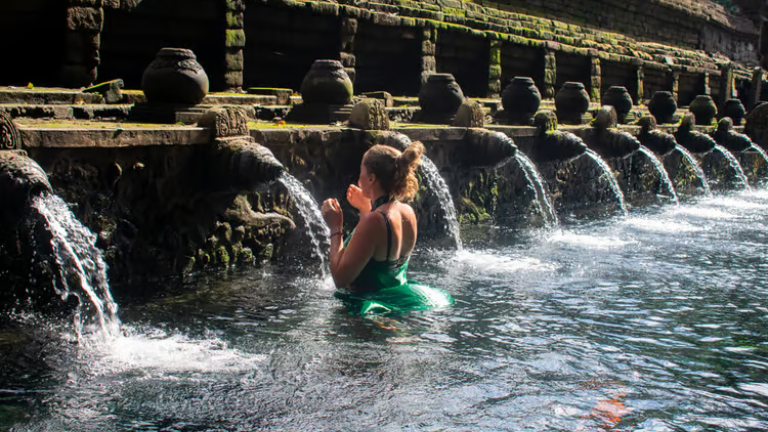
Pura Tirta Empul is a Balinese Hindu water temple built around a natural spring. Unlike temples centered on shrines alone, Tirta Empul’s main feature is a bathing complex where water flows through carved stone spouts into two long pools, where people queue to perform ritual purification.
Where is Pura Tirta Empul located?
The temple sits in Tampaksiring village, Gianyar regency, roughly 20–25 minutes north of central Ubud, and about a 5-minute drive from the Tirta Empul Presidential Palace. It’s easily combined with an Ubud-area itinerary, many visitors pair it with the Tegalalang Rice Terrace or a stop at a coffee plantation on the same route.
Why is Pura Tirta Empul famous?
It’s famous for its holy spring water and the melukat purification ritual, but also for its role in Balinese royal history and its inclusion as a filming location in a well-known Hollywood film, which introduced many international travelers to the temple for the first time.
How old is Pura Tirta Empul Temple?
Historical inscriptions date the temple’s founding to approximately 962 AD, making it roughly a thousand years old, one of the oldest continuously active water temples in Bali.
What is the history of Pura Tirta Empul?
According to Balinese historical accounts, the temple was founded during the reign of King Indrajaya of the Warmadewa dynasty. Local legend ties its creation to the mythological battle between the god Indra and the demon king Mayadenawa, who had poisoned a nearby water source; Indra is said to have struck the ground to create a pure, antidote spring, the origin of Tirta Empul’s holy water.
Who built Pura Tirta Empul?
The temple is attributed to King Indrajaya in the 10th century, with the site expanded and maintained by successive Balinese kingdoms over the following centuries as its spiritual importance grew.
What does the name Tirta Empul mean?
“Tirta” means holy or sacred water in Balinese-Sanskrit terminology, and “Empul” refers to a spring that gushes upward from the ground, together describing the temple’s central natural feature.
History & Culture
What is the historical significance of Tirta Empul?
Beyond its religious role, Tirta Empul has long been tied to Balinese royalty; the neighboring presidential palace (originally a Dutch-era rest house, later used by Indonesia’s first president) sits on the same water source, underscoring the site’s historical prestige.
What is the story behind Tirta Empul Temple?
The founding myth centers on purification and restoration, Indra’s spring counteracting Mayadenawa’s poison, which is why the temple has been associated with healing and cleansing for over a thousand years, not just ceremonial worship.
Why is Tirta Empul considered a sacred temple?
It’s classified as one of Bali’s important water temples (pura tirta), central to subak irrigation traditions and Balinese Hindu cosmology, where water is treated as a literal and spiritual life source connecting the mountains, temples, and rice fields.
What is the connection between Tirta Empul and Balinese Hinduism?
The temple embodies core Balinese Hindu concepts: the flow of holy water from Mount Batur’s watershed down through temples and irrigation channels reflects the belief system’s emphasis on balance between humans, nature, and the divine (Tri Hita Karana).
What makes Tirta Empul culturally important in Bali?
Locals still visit regularly for ceremonies, family blessings, and life milestones, this isn’t a site preserved only for tourism. Visiting on a Balinese ceremony day (your driver or guide can check the current Balinese calendar) offers a much richer, more authentic experience than an ordinary weekday visit.
Holy Water & Purification
Why is the water at Tirta Empul considered holy?
The water is believed to originate from a sacred spring blessed by Indra, and Balinese Hindus consider it spiritually potent for cleansing negative energy, illness, and misfortune, a belief reinforced by centuries of continuous ritual use.
What is the purification ritual at Tirta Empul?
Visitors queue along two stone pools, moving from spout to spout, submerging under each stream briefly while offering a short prayer, typically finishing at a final spout reserved for a specific step (some spouts are skipped for ceremonial reasons, a guide or temple attendant can point these out).
What is Melukat at Tirta Empul?
Melukat is the formal name for the Balinese Hindu purification ceremony performed here, a ritual bathing practice meant to spiritually cleanse the body and mind, often performed before important life events, after illness, or simply as a periodic spiritual reset.
Why do people bathe in the holy water at Tirta Empul?
Balinese Hindus and increasingly, curious travelers, bathe here seeking spiritual cleansing, clarity, or blessing, it’s treated as both a religious obligation and, for many locals, a genuinely meaningful personal practice.
What is the meaning of the purification ritual?
Each spout is believed to carry a slightly different purpose or blessing, and the sequential movement through the pool symbolizes progressively washing away impurities, negative energy, or misfortune.
Can tourists participate in the Melukat ritual at Tirta Empul?
Yes, tourists are generally welcome to participate respectfully, provided they follow dress code and etiquette (sarong required, modest conduct, no photography of others mid-ritual without permission).
Visiting Tirta Empul
What should you wear when visiting Tirta Empul?
A sarong and sash are required inside the temple grounds (usually available for rent or included with entry). For the purification pool itself, bring a change of clothes, many visitors wear a swimsuit or light clothing under the sarong.
What are the rules for visiting Tirta Empul Temple?
- Wear a sarong and sash at all times within temple grounds
- Women who are menstruating are traditionally asked not to enter the inner temple areas
- Avoid stepping over offerings placed on the ground
- Keep noise respectful — this is an active place of worship, not just a tourist site
- Ask before photographing people mid-ritual
What is the best time to visit Tirta Empul?
Early morning, ideally right at opening (around 8–9 AM), avoids both the tour-bus crowds and Bali’s midday heat. Afternoons, especially on weekends and Balinese ceremony days, get significantly busier.
How much does it cost to visit Tirta Empul?
Entry is inexpensive by international standards, with a small additional fee if renting a sarong on-site, modest enough that cost isn’t usually a deciding factor for most travelers.
How long does it take to explore Tirta Empul Temple?
Plan for 45 minutes to 1.5 hours, depending on whether you participate in the purification ritual, which adds queuing and changing time.
Can foreigners visit and enter Pura Tirta Empul?
Yes, foreigners are welcome both to view the temple and to take part in the purification ritual, provided they dress appropriately and follow guidance from temple staff.
What should tourists know before visiting Tirta Empul?
Because Tirta Empul is often combined with other central Bali stops, Tegalalang Rice Terrace, Ubud’s art markets, or even a longer day extending toward Bedugul or Kintamani, it’s worth checking with a local operator on realistic timing and traffic before finalizing a route, since exact pacing depends on your starting point, the day’s ceremony schedule, and how many stops you’re combining.
Frequently Asked Questions
Is Tirta Empul the same as the temple in “Eat Pray Love”? Tirta Empul was used as a filming location associated with the story, which significantly boosted its international recognition, though it existed as an active place of worship for centuries before that.
Do I need a guide to understand the ritual, or can I just show up? You can visit independently, but a guide adds real context, explaining which spouts to use, the meaning behind the sequence, and current temple etiquette, which changes slightly depending on ceremonies happening that day.
Is Tirta Empul suitable for a half-day trip from Ubud? Yes, it pairs naturally with a half-day Ubud-area itinerary alongside rice terraces or a coffee plantation stop, typically without needing a full separate day.
Is Tirta Empul appropriate for children or first-time visitors unfamiliar with temple etiquette? Yes, families visit regularly, just plan for modest dress, patience during the ritual queue, and a short etiquette briefing beforehand, which a local guide can easily provide.
Planning to include Pura Tirta Empul in your Bali itinerary? Docar Bali Tour can arrange a private tour in Bali that combines Tirta Empul with nearby highlights, from Tegalalang’s rice terraces to a full day extending toward Ubud, Bedugul, or beyond. Message us on WhatsApp through docarbalitour.com and we’ll help you plan a route and pace that fits your schedule.